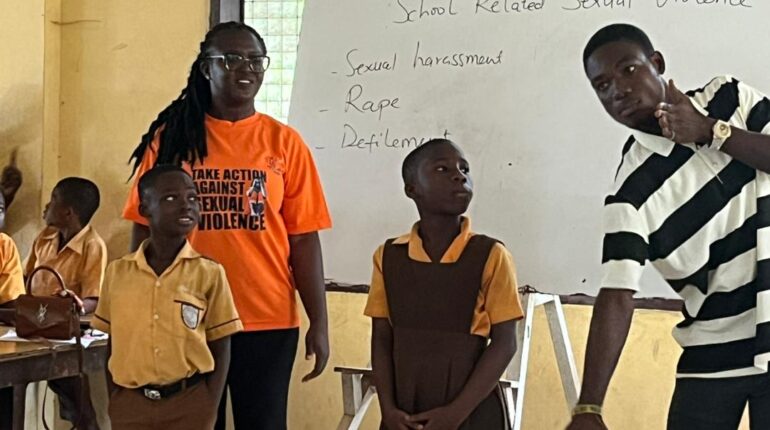
The morning assembly had just begun when we met the pupils at the Sekondi School for the Deaf. There were only twenty minutes before their breakfast break, but in those twenty minutes, important conversations took place.
Under the AWDF Kasa Project, Human Rights and Development Services (HURDS) engaged the students in an interactive session on Sexual and Gender-Based Violence (SGBV). Our focus was clear: to ensure that every child, regardless of ability, has access to knowledge that protects them.
Key topics including sexual harassment, defilement, rape, and physical abuse such as beating, fighting, and verbal insults were carefully written on the board and explained by the facilitator. Through sign language interpretation, the discussion was delivered in a way the students clearly understood, ensuring inclusivity and full participation. No child was left out of the conversation.
The discussion was grounded in real-life situations that can occur within schools and communities, making the engagement practical and relatable.
Then came the defining moment: the questions.
Using sign language through their interpreter, students boldly asked why adults prey on young girls, what to do if someone touches their private parts, how to respond when money is offered in exchange for sex due to poverty, and whether consensual sex between young people is right or wrong.
Their questions revealed curiosity, courage, and the realities children face daily.
In that short time, awareness was strengthened. Confidence was nurtured. Voices were encouraged.
At HURDS, we believe that access to information is protection. Children with disabilities must never be excluded from conversations about safety, rights, and dignity.
Leaving no one behind means ensuring that every child including those in special schools is equipped with the knowledge to recognize abuse, seek help, and stand up for themselves.
The fight against SGBV continues, and inclusion remains at the heart of our mission.